
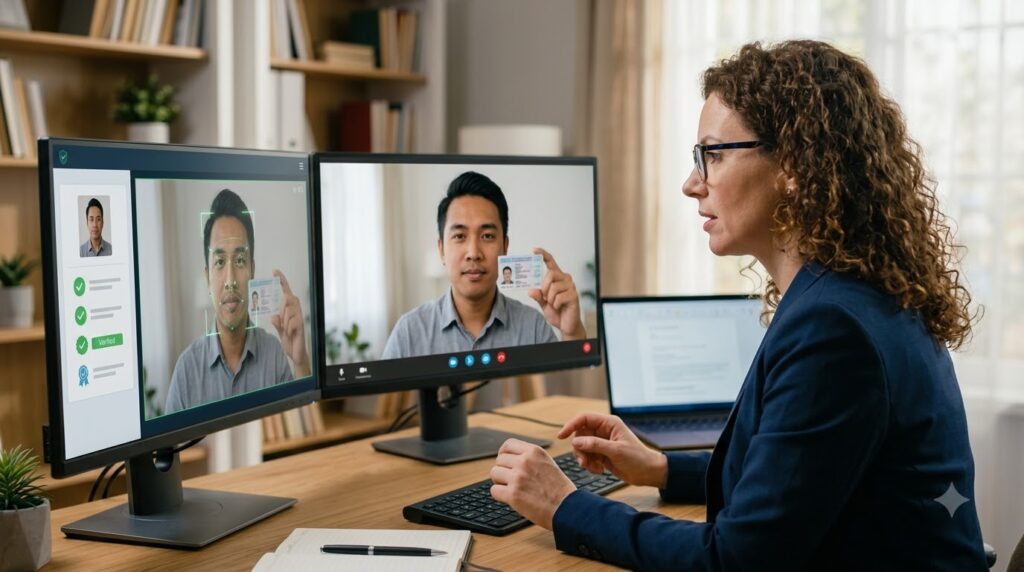
Remote hiring has changed how companies build technical teams.
Organizations can now hire software engineers, developers and IT specialists from different countries without geographical limitations.
This creates major advantages:
- Access to global talent
- Faster recruitment
- Flexible workforce models
- Specialized technical expertise
However, remote hiring also creates a critical challenge:
How can companies confirm that the person interviewed is actually the person who will perform the job?
A candidate may:
- Present an impressive resume
- Answer technical questions confidently
- Perform well during interviews
- Complete online assessments
Yet after hiring, companies may discover:
- Skills do not match expectations
- Communication patterns change
- The interviewed candidate is not the person performing the work
This is why remote IT hiring identity verification has become an important part of modern recruitment.
Identity verification is not only about confirming a person’s name.
It is about creating confidence that:
- The candidate is genuine
- Their skills are real
- Their experience is accurate
- Company systems remain protected
Quick Remote IT Candidate Verification Checklist
Before hiring a remote IT professional, companies should verify:
| Area | What To Check |
| Identity | Is the candidate the same person throughout the process? |
| Technical Skills | Can they actually perform the required work? |
| Experience | Are previous claims accurate? |
| Interview Integrity | Was the assessment completed independently? |
| Security | Will company systems remain protected? |
A reliable hiring decision requires more than a resume and video interview.
How Innovyt Helps Companies Build Reliable Remote IT Teams
Hiring remote developers requires more than finding available talent.
Companies need confidence that candidates are:
- Properly evaluated
- Technically capable
- Suitable for the role
- Ready for remote collaboration
Innovyt helps businesses create stronger remote IT hiring processes by focusing on:
- Technical talent evaluation
- Candidate screening
- Remote hiring support
- Building reliable IT teams
The goal is not simply filling positions.
The goal is connecting companies with professionals they can trust.
Why Remote IT Hiring Fraud Is Increasing
Remote Hiring Creates New Verification Challenges
Traditional hiring included:
- Office visits
- Face-to-face interviews
- Physical identification checks
- Direct interactions
Remote hiring often happens completely online:
- Resume submission
- Video interviews
- Technical assessments
- Offer letters
- Digital onboarding
While this makes recruitment faster, it also creates opportunities for dishonest candidates.
Companies may struggle to confirm:
- Who the candidate really is
- Whether credentials are genuine
- Whether assessments were completed independently
- Whether skills match expectations
Common Types of Remote IT Hiring Fraud
1. Proxy Interview Fraud
Proxy interviews happen when someone else participates in an interview on behalf of the actual candidate.
Example:
A candidate applies for a software engineering role.
During the technical interview, another experienced developer answers questions or completes assessments.
The company believes it is evaluating one person but is actually evaluating someone else.
Warning signs may include:
- Different communication styles
- Difficulty explaining previous answers
- Skills not matching interview performance
- Avoiding live problem-solving
2. Fake Technical Candidates
Technical roles require real skills.
A candidate may exaggerate:
- Programming experience
- Cloud knowledge
- Framework expertise
- Previous projects
A resume cannot fully prove technical ability.
Companies need both:
“Is this the correct person?”
and:
“Can this person actually perform the job?”
3. AI-Assisted Interview Fraud
AI tools can improve productivity, but they can also be misused during hiring.
Candidates may use:
- Generated answers
- Coding assistance
- AI-written responses
- External support during assessments
To evaluate real ability, companies should include:
- Live technical discussions
- Practical demonstrations
- Problem-solving exercises
- Scenario-based questions
4. Deepfake Interview Risks
Deepfake technology has introduced additional identity challenges.
A video call confirms that someone appears on camera.
It does not always confirm:
- Their true identity
- Their background
- Their technical capability
Modern remote hiring requires multiple verification layers.
The Complete Remote IT Hiring Verification Framework
A secure hiring process should not begin after a problem occurs.
Verification should be built throughout recruitment.
Step 1: Verify Candidate Identity
Before technical evaluation, confirm:
- Government identification
- Personal information
- Identity consistency across hiring stages
Identity verification creates a trusted foundation before candidates receive:
- Assessments
- Internal information
- System access
Step 2: Evaluate Technical Skills
Identity answers:
“Who is this person?”
Technical evaluation answers:
“Can this person perform the work?”
Companies should use:
- Live coding
- Technical discussions
- Architecture challenges
- Troubleshooting scenarios
- Real project simulations
Step 3: Validate Professional Experience
Verify:
- Previous employers
- Responsibilities
- Certifications
- Education
- References
A strong hiring process validates information instead of relying only on claims.
Step 4: Secure Remote Employee Onboarding
Verification should continue after hiring.
Companies should implement:
- Secure account creation
- Role-based permissions
- Controlled access
- Security training
Traditional Hiring vs Verified Remote Hiring
| Traditional Approach | Verified Approach |
| Resume-focused | Identity + skill validation |
| Interview-dependent | Multiple evaluation layers |
| Limited verification | Background checks |
| Higher uncertainty | Better hiring confidence |
| Access after hiring | Controlled onboarding |
How Companies Can Detect Fake IT Candidates Before Hiring
Hiring fraud is not always obvious.
A candidate may have:
- An impressive resume
- Strong communication skills
- Good interview preparation
But problems can appear when companies evaluate actual performance.
The goal is not assuming every candidate is suspicious.
The goal is creating a hiring process where genuine professionals can demonstrate their skills while reducing opportunities for fraud.
Warning Signs Companies Should Review
1. Resume Claims That Cannot Be Explained
A candidate may mention experience with:
- Complex software systems
- Advanced technologies
- Large-scale projects
- Multiple technical environments
During interviews, ask detailed questions about:
- Their specific contribution
- Technical decisions they made
- Problems they solved
- Challenges they faced
Real experience usually includes practical details.
2. Skill Level Does Not Match Interview Claims
One common warning sign is inconsistency between:
- Resume experience
- Interview performance
- Technical assessment results
Examples:
- Advanced experience listed but basic concepts are unclear
- Strong written answers but weak live discussions
- Difficulty explaining previous projects
Consistency across hiring stages helps create confidence.
3. Avoiding Live Technical Demonstrations
Technical skills are best evaluated through practical situations.
Companies should include:
- Live coding sessions
- Technical discussions
- Real-world scenarios
- Troubleshooting exercises
A candidate who understands their work should usually be able to explain their approach.
4. Sudden Changes In Communication Patterns
Companies can pay attention to:
- Different writing styles
- Different speaking patterns
- Unusual communication changes
These signs do not automatically prove fraud, but they can indicate that additional verification may be needed.
Building A Secure Remote IT Hiring Process
A secure remote hiring system should balance:
- Security
- Candidate experience
- Hiring efficiency
The purpose is not creating unnecessary barriers.
The purpose is creating trust.
Before The Interview: Establish Candidate Verification
Before moving forward, companies should focus on:
- Resume review
- Identity confirmation
- Background verification
- Initial qualification checks
This creates a stronger foundation before technical evaluation begins.
During The Interview: Confirm Authenticity
The interview stage should focus on:
- Live communication
- Technical discussions
- Practical evaluation
- Identity confirmation
The objective is understanding both:
- Who the candidate is
- What the candidate can actually do
After Hiring: Protect Company Systems
Verification should continue after the offer is accepted.
Companies should implement:
- Secure onboarding
- Access controls
- Permission management
- Security procedures
A verified employee should only receive access required for their role.
Why Identity Verification Alone Is Not Enough
Identity verification answers:
“Is this the correct person?”
But companies also need answers to:
“Can this person perform the role?”
and:
“Does this person’s experience match their claims?”
A complete hiring trust framework includes:
1. Identity
Confirm:
- Candidate information
- Personal details
- Hiring process consistency
2. Capability
Confirm:
- Technical skills
- Problem-solving ability
- Practical knowledge
3. Experience
Confirm:
- Previous work history
- Responsibilities
- Professional background
4. Security
Confirm:
- Safe access management
- Proper onboarding
- Protection of company resources
Technologies Supporting Remote Hiring Verification
Technology should support hiring decisions, not replace human evaluation.
A reliable hiring process combines tools with practical assessment.
1. Digital Identity Verification
Digital identity solutions help companies confirm candidate information through methods such as:
- Document verification
- Identity matching
- Authentication checks
For remote IT hiring, this creates confidence before providing access to sensitive systems.
2. Video Interview Authentication
Video interviews remain valuable, but additional verification can improve reliability.
Companies may use:
- Live identity confirmation
- Real-time interaction
- Verification steps
- Interview consistency checks
The goal is confirming that the person completing the hiring process is the same person receiving the offer.
3. Technical Assessment Platforms
For IT roles, technical evaluation is essential.
Assessment platforms can help evaluate:
- Coding ability
- Problem-solving
- Technical knowledge
- Practical decision-making
Skills should be demonstrated, not only described.
4. Background Verification
Background checks can validate:
- Employment history
- Education details
- Certifications
- References
This reduces uncertainty before hiring decisions are finalized.
Creating A Remote Hiring Verification Policy
Technology alone cannot prevent hiring fraud.
Companies need a clear process defining:
- Which roles require verification
- When checks happen
- Who reviews results
- How information is protected
- What happens if issues appear
A documented process creates consistency across hiring teams.
Balancing Hiring Security And Candidate Experience
Additional verification steps should not create unnecessary friction.
A professional process should feel:
- Transparent
- Simple
- Fair
- Consistent
Candidates should understand why verification exists.
A fair process protects genuine applicants by reducing advantages for dishonest candidates.
Remote Hiring Identity Verification Best Practices
1. Verify Early
Do not wait until after hiring problems appear.
Identity checks should happen before candidates receive important access or responsibilities.
2. Combine Multiple Verification Methods
No single step provides complete protection.
A stronger approach combines:
- Identity verification
- Technical assessment
- Background checks
- Interview evaluation
3. Train Hiring Teams
Recruiters and managers should understand:
- Suspicious behavior
- Verification gaps
- Unrealistic technical claims
- Candidate inconsistencies
4. Protect Candidate Data
Identity verification involves sensitive information.
Companies should:
- Store information securely
- Limit access
- Follow privacy requirements
- Use trusted verification processes
The Future of Remote Hiring: Identity, Skills, and Trust
Remote work has changed how companies build technical teams.
Organizations can now hire IT professionals across:
- Different cities
- Different countries
- Different time zones
This provides access to global talent, but it also increases the importance of trust.
Future-ready remote hiring will depend on combining:
- Digital identity verification
- Skill evaluation
- Background validation
- Secure onboarding
- Human decision-making
The future question is not only:
“Can companies find talented people remotely?”
It is:
“Can companies confidently verify and trust the people they hire remotely?”
How Companies Can Prepare For Secure Remote IT Hiring
A strong remote hiring process should focus on four major areas.
1. Strong Candidate Verification
Companies should confirm:
- Who is applying
- Who is completing interviews
- Who is receiving access after hiring
Identity verification creates the first layer of trust.
2. Practical Skill Evaluation
Resumes and interviews provide useful information, but real skills should be demonstrated through:
- Technical discussions
- Practical assignments
- Problem-solving scenarios
- Role-specific evaluations
The objective is understanding what candidates can actually do.
3. Secure Access Management
Hiring security does not end after selecting a candidate.
Companies should protect internal systems through:
- Controlled access
- Role-based permissions
- Security policies
- Proper onboarding
4. Continuous Process Improvement
Remote hiring risks continue to evolve.
Companies should regularly review:
- Verification methods
- Interview processes
- Security practices
- Hiring policies
How Innovyt Helps Companies Build Reliable Remote IT Teams
Finding remote IT talent is only one part of successful hiring.
Companies also need confidence that candidates:
- Have verified experience
- Match technical requirements
- Can collaborate remotely
- Fit the business requirements
Innovyt helps businesses strengthen their remote IT hiring process by supporting:
Remote IT Talent Acquisition
Companies can access technical professionals while maintaining a structured hiring approach.
Candidate Screening And Evaluation
A reliable hiring process should evaluate:
- Technical ability
- Professional experience
- Communication skills
- Role suitability
Building Long-Term Remote Teams
The goal of remote hiring is not only filling open positions.
It is building dependable teams that can contribute consistently over time.
A secure hiring approach helps businesses reduce uncertainty and make better hiring decisions.
Remote Hiring Identity Verification Checklist
Before hiring a remote IT professional, companies should review:
Identity Verification
✅ Confirm candidate identity
✅ Verify information consistency
✅ Ensure the same person completes each hiring stage
Technical Verification
✅ Conduct practical assessments
✅ Evaluate problem-solving ability
✅ Confirm claimed technical experience
Background Validation
✅ Verify previous employment
✅ Check references
✅ Validate credentials
Secure Onboarding
✅ Provide controlled access
✅ Apply security policies
✅ Follow role-based permissions
A layered approach creates stronger protection than relying on a single verification method.
Frequently Asked Questions About Remote Hiring Identity Verification
What Is Remote Hiring Identity Verification?
Remote hiring identity verification is the process of confirming that a remote candidate is the person they claim to be during recruitment.
It may include:
- Identity checks
- Document verification
- Interview verification
- Background validation
Why Is Identity Verification Important For IT Hiring?
IT professionals often access:
- Company systems
- Customer information
- Source code
- Technical infrastructure
Identity verification helps reduce risks related to:
- Fake candidates
- Resume fraud
- Unauthorized access
Are Video Interviews Enough To Verify Remote Candidates?
No.
Video interviews are useful, but they do not confirm everything.
Companies should combine:
- Identity verification
- Technical assessment
- Background checks
- Interview evaluation
How Can Companies Detect Fake IT Candidates?
Companies can reduce hiring risks by:
- Verifying identity
- Testing technical skills
- Checking employment history
- Conducting live assessments
- Reviewing inconsistencies
Can AI Create Risks In Remote Hiring?
Yes.
AI tools may create challenges when misused, including:
- Generated interview responses
- Assistance during assessments
- Misleading digital identities
Companies should design hiring processes that evaluate real capability.
What Is The Best Way To Prevent Remote Hiring Fraud?
The strongest approach is a layered verification strategy combining:
- Identity verification
- Technical evaluation
- Background checks
- Secure onboarding
No single step eliminates every risk, but multiple verification layers improve hiring confidence.
Final Thoughts: Building Trust Before Making The Hire
Remote hiring has created new opportunities for companies to build global IT teams.
However, hiring success depends on more than finding available candidates.
Companies need confidence that the person they hire:
✅ Is the correct individual
✅ Has the required technical skills
✅ Has accurate experience
✅ Can securely access company systems
The strongest remote hiring process combines:
Identity + Skills + Experience + Security
A reliable verification framework helps businesses reduce hiring risks, protect company resources and build stronger remote teams.
For organizations hiring remote IT professionals, the objective is not simply finding candidates.
The objective is finding the right people with confidence.